
Gurney vs Stretcher: What the Difference Actually Means for NEMT
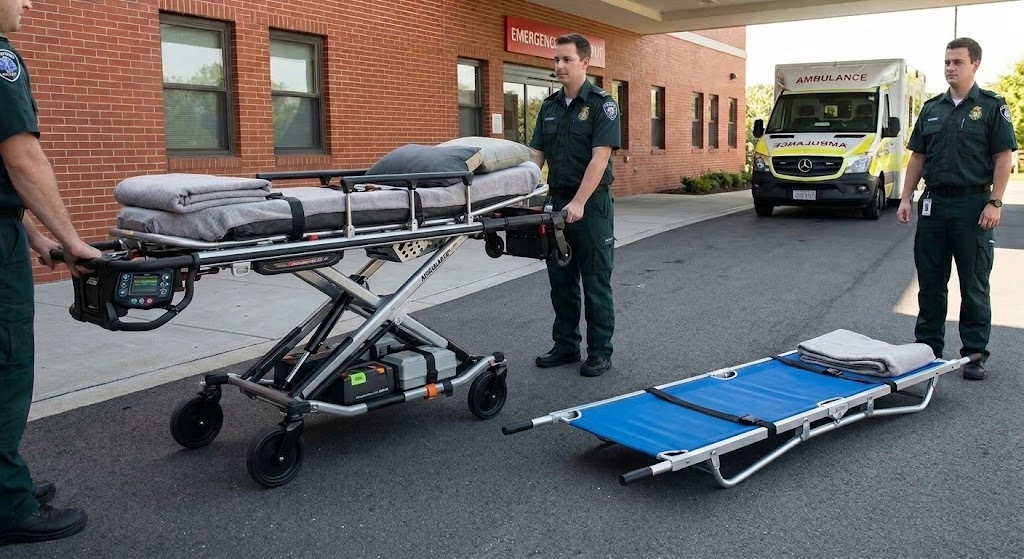
The gurney vs stretcher question comes up constantly in NEMT, and the two words get used almost interchangeably in casual conversation even though they describe meaningfully different equipment with different vehicle and staffing implications. Getting the difference between gurney and stretcher right matters for more than vocabulary. It affects which vehicle you dispatch, how many staff a trip actually needs, and in some cases what gets billed.
The basic difference between stretcher and gurney
A stretcher, in the traditional sense, is a lightweight, collapsible platform made of fabric stretched across a frame, historically designed to be carried by two or four people rather than rolled. A gurney is best understood as the evolution of that idea into a wheeled, mobile bed, generally with a rigid metal frame, wheels, and often motorized height adjustment features. If you are trying to settle the gurney vs stretcher question in one sentence, a gurney is essentially a stretcher that rolls and does not need to be physically carried.
When each one actually gets used
The difference between stretcher and gurney matters most in how a patient's condition determines which one a trip requires. A stretcher is generally appropriate for a patient with limited mobility who still has some ability to assist or tolerate being carried a short distance, and it tends to be used for shorter trips given the physical demands of carrying rather than rolling a patient. A gurney is generally required for a patient who is fully immobilized or bedridden and cannot be safely carried, and it is the more practical option for longer trips since it does not depend on staff physically carrying weight the entire distance.
Staffing and vehicle implications
This is where the gurney vs stretcher distinction has the most direct operational impact. A stretcher transport typically requires a minimum of two staff members to safely carry the patient, sometimes four depending on patient size and distance. A gurney, because it rolls, can often be moved by a single trained staff member, even though many operations still staff two for safety and to assist with loading and unloading. Vehicle needs differ too. Stretchers are collapsible and require comparatively little dedicated space, while gurneys have a rigid frame that takes up meaningfully more room, which is one of the reasons stretcher van conversions are specifically built around gurney dimensions rather than a general cargo layout.
Cost and capacity considerations
Gurneys generally cost more than stretchers, reflecting the additional frame, wheels, and often motorized features, which is a real factor when outfitting a new vehicle. On the capacity side, a metal framed gurney is generally built to accommodate patients of a wider weight range than a fabric stretcher, which is meant to prioritize portability over maximum load capacity. For an operation regularly transporting bariatric patients, this capacity difference is often the deciding factor rather than trip distance alone.
How this affects billing and documentation
Transportation costs for stretcher and gurney trips both vary widely by region and payer, commonly running anywhere from a few hundred dollars to over a thousand dollars depending on distance and level of service, and insurance coverage for either varies by the specific payer and plan. Because the equipment and staffing requirements differ, documenting which one a trip actually used, not just that it was a stretcher level trip in general, is worth building into a standard trip record, since it is the kind of detail that can matter if a claim is ever questioned.
How to decide which one a specific trip needs
The practical test comes down to two questions: can this patient tolerate being physically carried for the length of this specific trip, and does the patient's weight or size fall within what your available equipment safely supports. A patient who can be carried a short distance and does not exceed a stretcher's weight capacity may not need a gurney at all, while a patient requiring a longer trip or exceeding stretcher capacity needs a gurney regardless of distance. Getting this right at the scheduling stage, rather than discovering a mismatch at pickup, is one of the more common gaps in NEMT dispatching, and it is exactly the kind of detail that benefits from accurate intake information rather than a generic trip request. Dispatchers who treat gurney vs stretcher as a real intake question, not an afterthought, tend to see fewer mismatched vehicles showing up at the door.
Frequently asked questions
What is the main difference between a gurney and a stretcher? A stretcher is a lightweight, collapsible platform typically carried by two to four staff members, while a gurney is a wheeled, often motorized mobile bed that can generally be moved by a single trained staff member. A gurney is essentially a wheeled evolution of the stretcher concept.
Which one is used for longer trips, a gurney or a stretcher? Gurneys are generally the better fit for longer trips since they roll rather than requiring staff to physically carry the patient the full distance. Stretchers are more commonly used for shorter transports.
Does a gurney vs stretcher choice affect vehicle requirements? Yes. Gurneys have a rigid frame that requires more dedicated vehicle space than a collapsible stretcher, which is why stretcher van conversions are specifically built around gurney dimensions rather than general cargo space.
How many staff members are needed for a stretcher versus a gurney transport? Stretcher transport typically requires a minimum of two staff members, sometimes four depending on patient size and distance, since the patient is being carried. Gurney transport can often be handled by a single trained staff member since the gurney rolls.
Is a gurney or a stretcher better for a bariatric patient? A gurney is generally the better option for a larger patient, since its metal frame is built to accommodate a wider weight range than a fabric stretcher, which is designed to prioritize portability over maximum load capacity.
Getting the right vehicle and staffing to the right trip starts with accurate intake information at the scheduling stage. If you want to see how RoutingBox handles equipment and mobility requirements as part of trip scheduling, you can schedule a demo at routingbox.com.
Ready to upgrade your NEMT software?
Talk to our Team of Experts and let's make RoutingBox part of your story as well.